
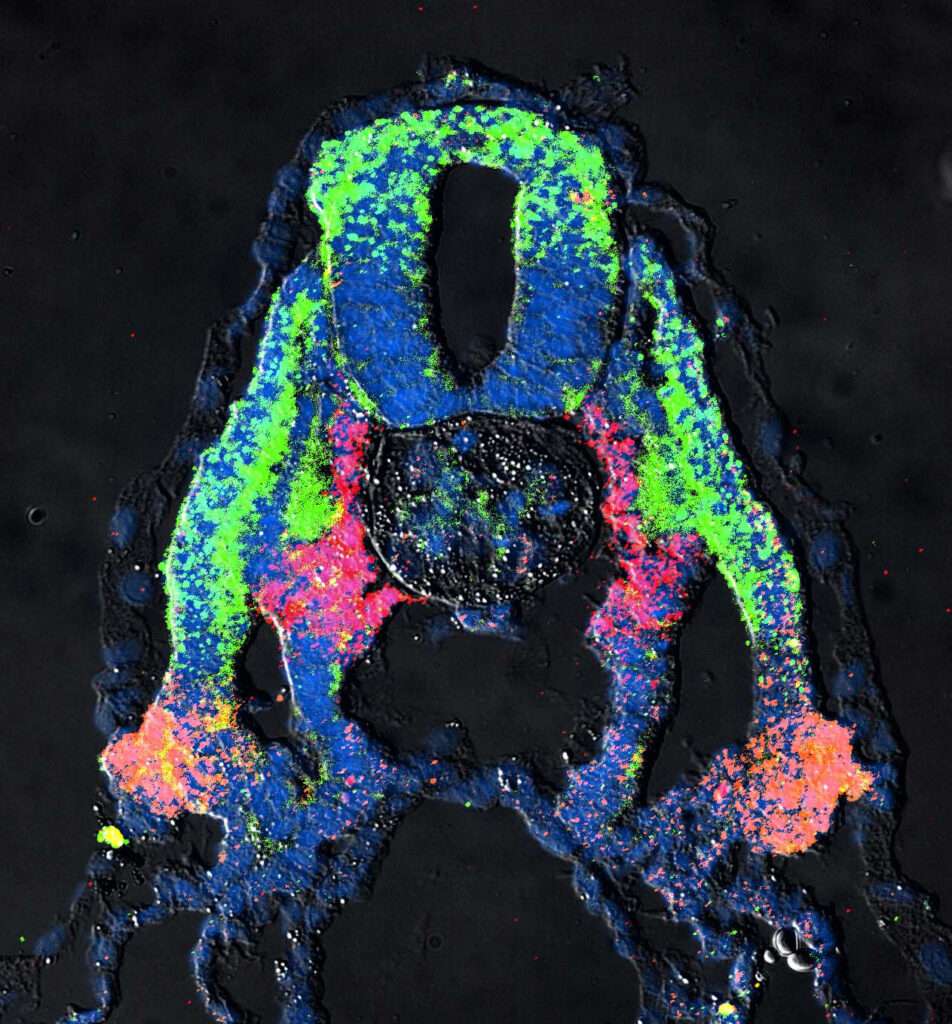
A study published in the journal Science Advances found that the first cells from which the kidney develops originate in an embryonic region that also gives rise to muscles, tendons, and parts of the skeleton, offering new evidence for a scientific discovery first proposed in 1888.
A new study conducted at the University of Haifa and published in the prestigious journal Science Advances has found that the origin of the kidney in vertebrates may be different from what has long been accepted. The study provides new evidence for a scientific idea first proposed in 1888 but never adopted as a central concept in the field. According to the study, the first cells from which the kidney develops do not originate solely from the embryonic tissue previously thought to be its source, but rather from an embryonic region that is also the area where the muscles, tendons, vertebral column, and other parts of the axial skeleton develop. “This finding is not merely a minor correction to the evolutionary developmental model of the kidney. It changes the way we examine connections between body systems during the earliest stages of embryonic development, suggesting that processes that seemed to be separate may be more deeply linked than we thought, with foundations that lie deep in evolution,” said Dr. Ram Reshef of the University of Haifa, who led the study.
To understand the significance of the study’s main finding, we must return to a very early stage of embryonic development, long before the kidney takes on its familiar form. In vertebrates, the kidney develops in stages: first, the pronephric kidney appears in the anterior region of the embryo, at the boundary between the head and neck, while subsequent stages of the renal system develop until the mature kidney forms in mammals, birds and reptiles. For decades, the prevailing explanation was that the process begins in a narrow strip of embryonic tissue known as the intermediate mesoderm, which is also the source of the reproductive organs. In the current study, Dr. Reshef, doctoral student Pascal Schmidt, and researchers in his Lab at the department of Evolutionary and Environmental Biology at the University of Haifa, together with a team of researchers from the Technion, two CNRS teams of the Sorbonne University in France, and the University of Genoa in Italy, sought to determine the embryonic and evolutionary origin of the pronephric kidney, identify the molecular mechanisms that regulate its development, and test whether the prevailing view accurately describes the beginning of the process.
In the present study, the researchers used a comparative approach to examine embryos of three animals representing key points in the vertebrate evolutionary tree. The first was the amphioxus, a small marine animal closely related to vertebrates but lacking an axial skeleton, providing a glimpse into a particularly early stage in the evolution of vertebrate body structure. The second was the European river lamprey, a jawless fish lacking paired fins that represents one of the most ancient groups of vertebrates. The third was the small-spotted catshark, a cartilaginous fish with jaws that exemplifies another early stage in vertebrate evolution. The researchers tracked the expression of early molecular markers of kidney development, including the genes Pax2 and Lim1, and examined exactly where they appeared in embryos of the studied species. In addition to their observations, the researchers conducted an intervention experiment in which they blocked the Sonic hedgehog signaling pathway, one of the key regulatory mechanisms in embryonic development, to determine whether this pathway, which is involved in the development of the vertebral column and axial skeleton, also affects the initiation of kidney development. The combination of evolutionary comparisons across several early species, molecular labeling, and advanced imaging enabled the researchers to track the process not only according to tissue morphology but also according to the molecular identity of the cells.
The study’s findings show that in shark embryos and European river lamprey embryos, the first cells from which the pronephric kidney develops are located within the somite, an embryonic sphere unit repeated along the length of the embryo and serving as the source of several major tissues, including muscles, the skin of the back, tendons, and parts of the skeleton. The researchers identified this region as the nephrotome, the technical scientific term for the region from which the kidney develops. According to the researchers, the finding suggests that the somite is not only associated with the development of the locomotor and skeletal systems, but also contains a region from which kidney cells begin to develop. In amphioxus, a marine animal closely related to vertebrates but not itself a vertebrate, it is already known that an excretory organ develops from such an embryonic unit as well, evidence that strengthens the possibility that this is a very ancient evolutionary source. Another finding concerns the regulatory mechanism of the process: blocking the Sonic hedgehog signaling pathway, known to regulate the development of the vertebrae, also impaired pronephric kidney development in the shark and lamprey, but not in amphioxus, which lacks vertebrae. This finding points to a developmental connection between vertebrae and the pronephric kidney. It therefore appears that during evolution not only did the cellular origins of kidney development change, but so too did the regulatory mechanisms directing the process. “The importance of this finding is that it changes the questions we ask about the way the body is built,” said Dr. Reshef. “If the beginning of kidney development is linked to a region that also gives rise to components of the skeletal system, this may eventually help us better understand conditions in which defects of the kidney and bones appear together. This is not a promise of a medical treatment, but rather a deeper understanding of the relationships between body systems during the earliest stages of embryonic development.”
According to the researchers, one of the most interesting aspects of the study is its historical dimension. As early as 1888, Johannes Rückert, a German researcher specializing in embryonic development, believed that the origin of the kidney in sharks lay within the somite. “Now, using molecular tools and advanced imaging, the new study provides evidence that Rückert had already identified an important process that the technology of his time could not prove,” the researchers said.